
Arts in health professionals use a variety of approaches to support the wellbeing of healthcare patients and staff, in hospitals and also in long-term care facilities. This might include anything from listening to recordings to a live performance at a patient’s bedside, or getting staff and families to sing and play along, and even improvising new music with patients and families.
In hospitals
Music for health projects are enhancing the well-being of patients and staff in hospitals around the Netherlands. For instance, the Boedijn music school and Dijklander Hospital are collaborating on a multi-year partnership called Muziekmaatjes (Music Buddies), using live music to create moments of relaxation, escape, and joy, among pediatric patients and their parents. Another initiative specifically designed for children is "De Liedjesfabriek’" (The Song Factory), in which children write their own songs under the guidance of a music professional. Children from all over The Netherlands get to write and record their own song on the topic they choose and in the style of music they want.
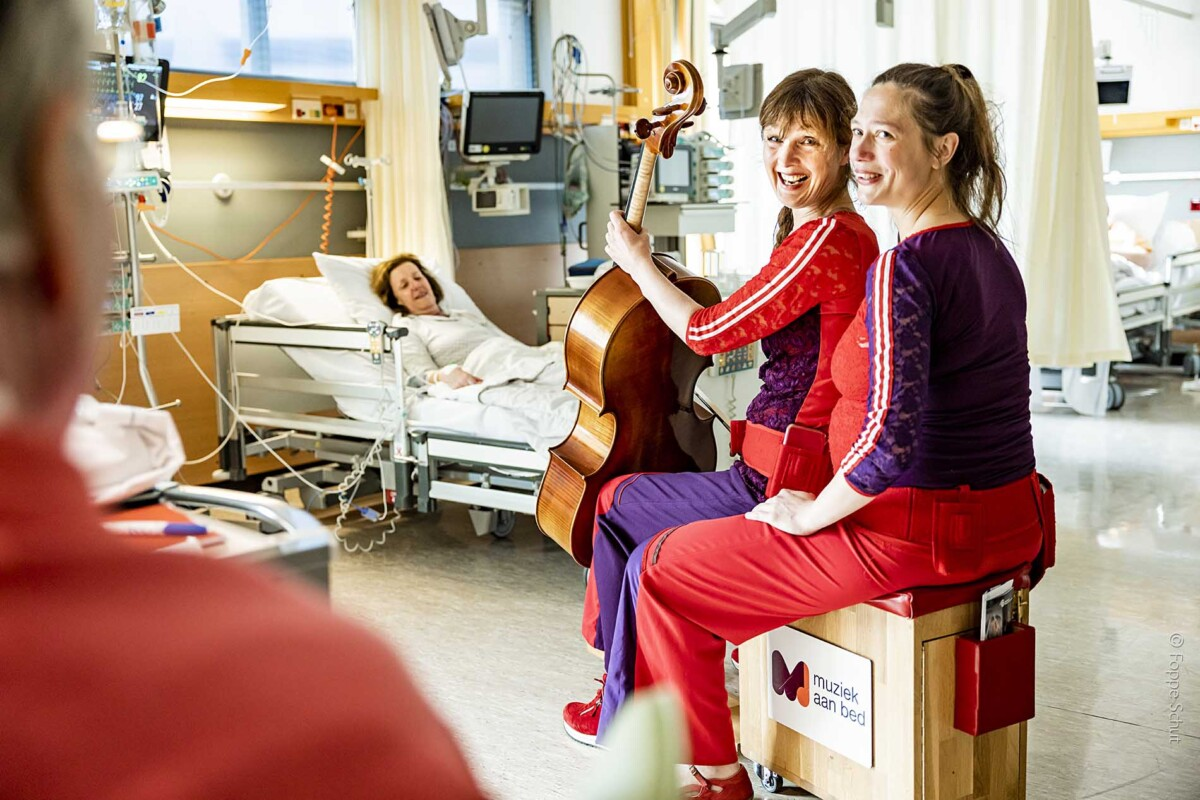
Music for health can even be found in hospital intensive care units. One example of this is the organisation MuzIC that works with interested hospitals throughout The Netherlands, supporting the recovery of patients, which can minimize the health impacts of an ICU stay. Also the organisation ‘Muziek aan bed’ (Music at the bedside) provides musical interventions on all hospital wards.
Outside the hospital
Music in health is also found in rehabilitation centers and hospices. For example, the organization Muziek aan Bed brings live music to people living with dementia in nursing homes through its Muziek aan tafel (Music at the Table) program, where everyone sings along, conducts, or moves. Professional Arts in Health organizations such as Mimic and Embrace Nederland encourage music-making in institutions as well as in private homes. Embrace Nederland also works to build social cohesion in the social domain, for example, with its "Slagkracht" project. Both Embrace Nederland and Mimic provide workshops for healthcare professionals and informal caregivers, teaching them to incorporate music into their daily interactions with patients and families.

What the science says
There is evidence that music contributes to recovery from illness, reducing pain, stress, anxiety, and depression. There are even indications that music can positively influence the immune system's responses.
In private homes, music in health professionals provide real support for people living with neurological conditions such as stroke, Parkinson's disease, or dementia.
Music appears to have positive effects on people with neurological disorders, activating the areas of the brain involved in thinking, feeling, movement, and emotion.
Research suggests that music can be a powerful tool to support the wellbeing of healthcare professionals and informal caregivers, by encouraging relaxation, building social connection, and helping staff to reflect on their work in new ways.
A study by Mimic suggests that music leads to stronger, positive contacts between patients and nurses, as well as an increase in compassion in nurses.
Professors Dick Swaab and Erik Scherder gave a lecture on Music and the Brain, which beautifully explains the positive health effects of music.
Organizations in the Netherlands in the field of Music in Health
There are many more organizations offering music in health services in hospitals, long-term care, and the social domain. Below is an overview:
- Bedside Buskers
- Muziekids
- Zingen in de Zorg
- Hier is Muziek!
- Muziek voor de Zorg
- Genetic choir
- REVA BEATS
- Stichting Muziek in Huis
- Zing mee in het Participatiekoor
- Bedside Singers – Zingen voor de ziel op reis)
- MuzIC
- Mimic muziek
- ThuisMuziekZorg
- De Liedjesfabriek
- Muziek Aan Bed